Managing employee leave through Excel sheets, emails, WhatsApp messages or manual registers can become difficult as a business grows. HR teams need to track leave balances, approvals, holidays, attendance, compensatory leave, loss of pay and payroll calculations without creating unnecessary administrative work.
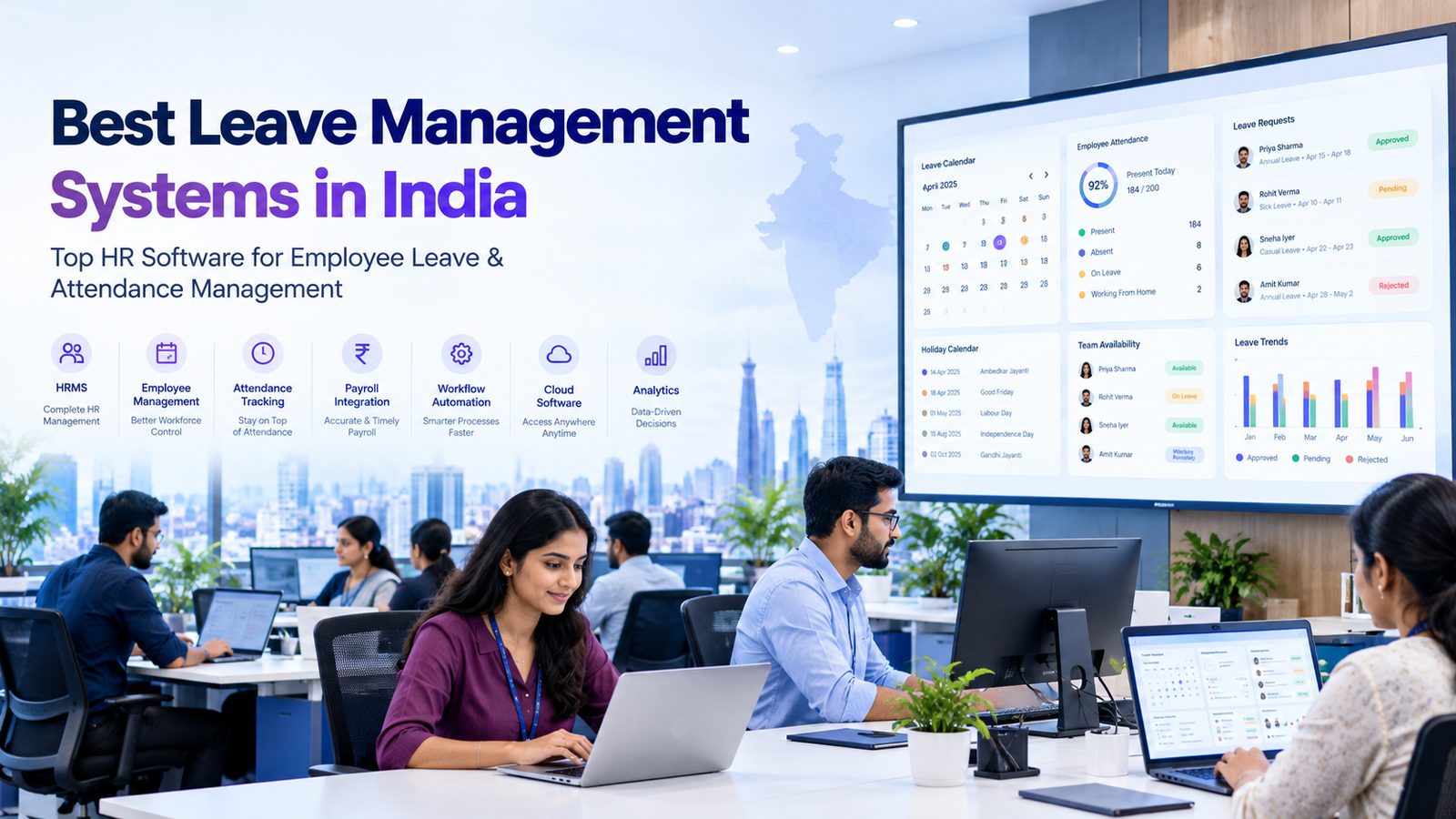
A leave management system helps businesses digitize this entire process. Employees can apply for leave online, managers can approve or reject requests, and HR teams can manage leave policies, balances, holidays and reports from a centralized platform.
For startups, small businesses and growing companies, choosing the right leave management software in India can also make it easier to connect leave data with attendance and payroll.
In this guide, we compare 10 popular leave management systems in India in 2026, including greytHR, Keka, Zoho People, Darwinbox, factoHR, HROne, Pocket HRMS, Zimyo, Qandle and PeopleStrong.
Quick Answer: The right leave management system depends on your workforce size, leave policies, payroll requirements, attendance setup, budget and HR automation needs. Businesses should compare policy customization, leave accrual, approvals, mobile access, payroll integration, reporting and scalability before selecting a platform.
What Is a Leave Management System?
A leave management system is software that helps organizations manage employee time-off requests digitally.
Instead of maintaining separate spreadsheets or email records, HR teams can use one centralized system to manage:
- Leave applications
- Leave approvals
- Leave balances
- Leave types
- Leave policies
- Holiday calendars
- Leave accrual
- Carry-forward rules
- Leave encashment
- Compensatory leave
- Loss of pay
- Employee attendance
- Leave reports
- Payroll-related leave data
Employees can generally use an employee self-service portal or mobile application to apply for leave and check their available balance, while managers can review and approve requests.
For a growing business, this creates a more structured process and reduces the amount of manual HR administration.
Know morw About: Best Digital Marketing Institutes in Noida
10 Best Leave Management Systems in India
The following platforms are popular options to evaluate when looking for leave management software or a complete HRMS.
1. greytHR
Best suited for: Small, medium and growing businesses looking for a broader HRMS with leave, attendance and payroll capabilities.
greytHR is an established HRMS platform that includes leave management as part of its wider employee-management ecosystem.
Its leave functionality can be useful for businesses that want to move away from spreadsheets and connect employee leave information with other HR processes.
Key areas to evaluate include:
- Leave policy management
- Leave types
- Leave balances
- Leave approvals
- Holiday management
- Employee self-service
- Attendance integration
- Payroll integration
- Leave reports
- Mobile access
One advantage of using an HRMS rather than a standalone leave tracker is that employee information, attendance, leave and payroll workflows can be managed within a connected environment.
Best for: Businesses looking for a full HRMS rather than only a basic leave tracker.
2. Keka
Best suited for: Growing businesses and organizations looking for configurable leave policies, employee self-service and payroll-connected HR workflows.
Keka provides a dedicated leave management system within its HR platform.
Businesses can configure different leave types and policies according to their organizational requirements. The platform also supports leave applications, approvals, leave balances and employee access through its HR environment.
Important features to consider include:
- Custom leave policies
- Paid and unpaid leave
- Sick and statutory leave
- Leave accrual
- Comp-off
- Leave approval workflows
- Shared leave calendar
- Leave balance tracking
- Mobile application
- Payroll integration
- Leave reports
Keka also provides documentation around leave plans, accrual rules, approval workflows, probation and notice-period configurations and year-end processing.
Best for: Companies that need more advanced leave rules and integration with broader HR and payroll operations.
3. Zoho People
Best suited for: Startups, SMEs and businesses already using the Zoho ecosystem.
Zoho People offers a dedicated time-off and leave management service.
Businesses can create customized leave policies based on employee groups, locations, roles and other organizational requirements.
Important features include:
- Custom leave policies
- Leave types
- Leave accrual
- Leave approvals
- Multiple approval levels
- Compensatory off
- Holiday calendars
- Leave grants
- Leave balance management
- Mobile application
- Reports
- Payroll integration
Another useful feature for distributed organizations is calendar integration, which can help teams view time-off information alongside workplace calendars.
Best for: Businesses that want configurable HR software and integration with other business applications.
4. Darwinbox
Best suited for: Larger organizations and enterprises requiring a broader HR and workforce management platform.
Darwinbox is positioned as a comprehensive HR technology platform rather than simply a leave-tracking application.
For larger companies, leave management is generally connected with other HR processes such as employee data, attendance, workforce management, payroll and employee experience.
Businesses evaluating Darwinbox should consider:
- Leave management
- Employee self-service
- Attendance
- Workforce management
- HR workflows
- Reporting and analytics
- Mobile access
- Payroll connectivity
- Multi-location requirements
- Enterprise scalability
Best for: Medium-to-large organizations that need leave management as part of a broader enterprise HR platform.
5. factoHR
Best suited for: Businesses looking for an HRMS combining leave, attendance, payroll and employee self-service.
factoHR provides leave management functionality as part of its HRMS.
The platform is designed to digitize processes that are traditionally handled through spreadsheets, emails and manual HR workflows.
Businesses can evaluate features such as:
- Online leave applications
- Leave balances
- Multiple leave types
- Leave approval workflows
- Employee self-service
- Mobile access
- Attendance integration
- Payroll integration
- Leave reports
- Policy configuration
For businesses with field employees or hybrid teams, it is also worth evaluating how leave functionality works alongside the platform’s attendance capabilities.
Best for: Growing businesses looking for connected HR, attendance, payroll and leave workflows.
6. HROne
Best suited for: Organizations looking for a broader HRMS with configurable leave and attendance management.
HROne is another HRMS platform that includes leave management within its HR technology suite.
A business evaluating HROne can look at:
- Leave policy management
- Leave types
- Leave balances
- Leave approvals
- Holiday calendars
- Leave credit schedules
- Attendance
- Payroll
- Employee self-service
- Reports
- Mobile HR functionality
Leave management becomes more valuable when it is connected to attendance and payroll because HR teams can avoid maintaining separate records.
Best for: Businesses looking for an integrated HRMS with configurable employee-management workflows.
7. Pocket HRMS
Best suited for: Small and medium businesses looking for cloud-based HR and employee self-service functionality.
Pocket HRMS provides HRMS functionality covering areas such as employee management, attendance, leave and payroll.
For leave management, businesses should evaluate:
- Leave applications
- Leave approvals
- Leave balances
- Leave policies
- Holiday calendars
- Employee self-service
- Mobile access
- Attendance integration
- Payroll integration
- HR reports
The employee self-service approach can reduce repetitive HR queries because employees can access their own leave information instead of contacting HR for every balance or request.
Best for: SMEs looking for a cloud HRMS with employee self-service.
8. Zimyo
Best suited for: Growing businesses looking for configurable HR and employee-management workflows.
Zimyo provides HR technology covering employee management and time-and-attendance-related processes.
When evaluating Zimyo for leave management, businesses should look at:
- Leave policies
- Leave types
- Leave balances
- Leave approvals
- Holiday management
- Attendance
- Employee self-service
- Mobile access
- Reports
- HR automation
For companies with different employee categories or multiple locations, policy flexibility should be one of the important evaluation criteria.
Best for: Growing organizations that want leave management within a broader HR platform.
9. Qandle
Best suited for: Businesses looking for configurable HR workflows and employee self-service.
Qandle is an HRMS platform that can be considered when businesses want to centralize employee-related processes.
For leave management, companies should compare:
- Leave policy configuration
- Leave applications
- Approval workflows
- Leave balances
- Holiday calendars
- Employee self-service
- Attendance
- Payroll connectivity
- Reporting
- Mobile experience
The main benefit of using a broader HRMS is that leave data can become part of a larger employee lifecycle rather than remaining isolated in a separate application.
Best for: SMEs and growing companies looking for a configurable HRMS.
10. PeopleStrong
Best suited for: Medium and large organizations with broader workforce and HR requirements.
PeopleStrong is positioned as a comprehensive HR and workforce technology platform.
Organizations evaluating it for leave management should look beyond basic leave applications and examine how leave connects with:
- Core HR
- Attendance
- Payroll
- Workforce management
- Employee self-service
- Reporting
- Analytics
- Mobile HR
- Enterprise workflows
For larger organizations, scalability and integration can be just as important as the number of leave features available.
Best for: Medium-to-large organizations looking for a broader HR technology platform.
Comparison of Leave Management Systems in India
| Software | Leave Management | Attendance | Payroll Integration | Mobile/ESS | Suitable For |
|---|---|---|---|---|---|
| greytHR | Yes | Yes | Yes | Yes | SMEs & growing businesses |
| Keka | Yes | Yes | Yes | Yes | Growing & larger businesses |
| Zoho People | Yes | Yes | Yes | Yes | Startups & SMEs |
| Darwinbox | Yes | Yes | Yes | Yes | Enterprises |
| factoHR | Yes | Yes | Yes | Yes | SMEs & growing companies |
| HROne | Yes | Yes | Yes | Yes | Mid-size & large businesses |
| Pocket HRMS | Yes | Yes | Yes | Yes | Small & mid-size businesses |
| Zimyo | Yes | Yes | Yes | Yes | Growing organizations |
| Qandle | Yes | Yes | Yes | Yes | SMEs & growing companies |
| PeopleStrong | Yes | Yes | Yes | Yes | Enterprises |
Note: Exact features and availability can depend on the selected product plan, configuration and integrations. Businesses should verify the current feature list with the vendor before purchasing.
Key Features to Look for in Leave Management Software
Choosing software only because employees can submit leave requests is not enough.
A business should evaluate the complete leave lifecycle.
1. Custom Leave Policies
Every organization can have different leave rules.
Your system should ideally allow HR teams to configure:
- Casual leave
- Sick leave
- Earned leave
- Privilege leave
- Maternity leave
- Paternity leave
- Comp-off
- Unpaid leave
- Bereavement leave
- Optional holidays
- Organization-specific leave
The ability to create rules for different departments, locations, employee categories or employment stages can be particularly useful for growing businesses.
2. Automated Leave Accrual
Manual calculation of leave balances becomes difficult as employee numbers increase.
Look for software that can automate:
- Monthly accrual
- Annual accrual
- Pro-rated leave
- Joining-date calculations
- Attendance-based accrual
- Carry-forward
- Leave expiry
- Encashment
3. Leave Approval Workflows
Different organizations have different approval structures.
A good system should allow businesses to configure approval workflows based on factors such as:
- Reporting manager
- Department
- Leave type
- Number of days
- Employee level
- Location
Multi-level approval can be particularly useful for larger organizations.
4. Employee Self-Service
Employee self-service can reduce the administrative workload for HR teams.
Employees should ideally be able to:
- Apply for leave
- Check leave balance
- View leave history
- Check holidays
- Cancel eligible requests
- View approval status
- Request compensatory leave
5. Attendance Integration
Leave and attendance are closely connected.
For example, an employee’s absence can affect:
- Attendance records
- Working days
- Loss of pay
- Overtime
- Payroll
- Leave balance
Therefore, businesses should check whether their chosen leave management system can integrate these processes.
6. Payroll Integration
This is one of the most important features for businesses.
Leave information can affect salary calculations through:
- Loss of Pay
- Leave encashment
- Paid/unpaid leave
- Attendance-based salary
- Arrears
- Final settlement
Connecting leave and payroll can reduce duplicate data entry and reconciliation work.
7. Holiday Calendar
Businesses operating across different locations may need multiple holiday calendars.
Look for options such as:
- Location-specific holidays
- Department-specific holidays
- Optional holidays
- Restricted holidays
- Regional holidays
- Weekly offs
8. Mobile Application
Employees and managers increasingly expect HR processes to work from mobile devices.
A mobile application can allow employees to:
- Apply for leave
- Check balances
- View holidays
- Receive notifications
- Approve requests
Managers can also approve requests without opening a desktop HR system.
Benefits of a Leave Management System for Businesses
Reduces Manual HR Work
Instead of processing every request through email or spreadsheets, businesses can automate the process.
Improves Leave Visibility
Managers can see who is absent, who has requested leave and how much leave employees have available.
Reduces Calculation Errors
Automated balances and payroll-connected data can reduce manual calculations.
Improves Employee Experience
Employees don’t need to contact HR every time they want to know their leave balance.
Helps Workforce Planning
Managers can identify periods when multiple employees are scheduled to be away.
Centralizes HR Data
Leave information can be stored alongside employee, attendance and payroll information.
Leave Management System vs HRMS
A leave management system can be a standalone application or a module within a larger HRMS.
| Leave Management System | HRMS |
|---|---|
| Focuses mainly on employee leave | Covers multiple HR processes |
| Leave applications | Employee records |
| Leave balances | Leave |
| Leave approvals | Attendance |
| Holiday calendars | Payroll |
| Leave reports | Recruitment |
| Basic employee self-service | Performance |
| May integrate with payroll | Employee lifecycle |
For a very small business that only needs leave tracking, a dedicated tool may be sufficient.
However, startups planning to grow their workforce may prefer an HRMS that combines leave, attendance, payroll and employee management.
How to Choose the Right Leave Management Software
Before buying a system, create a checklist based on your actual HR requirements.
Step 1: Define Your Workforce Size
Consider whether you have:
- 10–50 employees
- 50–200 employees
- 200–500 employees
- 500+ employees
The ideal platform can vary significantly by workforce size.
Step 2: Identify Your Leave Policies
List every leave type currently used by your company.
Then check whether the software can reproduce those rules accurately.
Step 3: Check Attendance Integration
If you already use biometric, GPS, web or mobile attendance, check whether the leave system can connect with it.
Step 4: Check Payroll Integration
Find out how approved leave affects payroll.
Ask specifically about LOP, encashment and attendance-based calculations.
Step 5: Test the Employee Experience
Ask employees to test:
- Leave application
- Balance checking
- Approval tracking
- Mobile application
- Holiday calendar
Step 6: Ask About Data Migration
If your company currently uses Excel, ask the vendor how historical leave balances and employee information will be migrated.
Step 7: Understand Pricing
Don’t compare only the headline subscription price.
Check:
- Per employee pricing
- Minimum employee count
- Setup charges
- Implementation fees
- Payroll module cost
- Attendance module cost
- Mobile features
- Support
- Additional integrations
Leave Management Software for Startups
Startups generally need software that is easy to implement and doesn’t create unnecessary administrative complexity.
Important features include:
- Simple leave policies
- Employee self-service
- Mobile access
- Attendance integration
- Payroll integration
- Affordable pricing
- Easy implementation
- Scalability
A startup should avoid paying for enterprise functionality that it does not currently need unless rapid workforce growth justifies it.
Leave Management Software for SMEs
For SMEs, integration becomes increasingly important.
An SME may benefit from a system combining:
Employee Management + Leave + Attendance + Payroll + Reports
This can reduce the need to maintain separate systems.
Leave Management for Multi-Location Businesses
Businesses operating in different cities or states may require separate policies and holiday calendars.
Before purchasing software, verify whether it supports:
- Multiple locations
- Location-specific policies
- Different holiday calendars
- Different employee groups
- Multiple approval structures
- Location-based reporting
Common Mistakes When Choosing Leave Software
Choosing Only Based on Price
The cheapest system may not provide the policy flexibility your business requires.
Ignoring Payroll Integration
Leave without payroll integration can result in continued manual work.
Not Testing Mobile Features
If employees work remotely or across locations, mobile access can be important.
Not Checking Policy Flexibility
A system may look good in a demo but fail to support your company’s actual leave rules.
Ignoring Data Migration
Moving from Excel to HRMS requires historical employee and leave data to be handled properly.
Buying More Features Than Needed
A small business doesn’t necessarily need every enterprise HR feature.
Frequently Asked Questions
What is a leave management system?
A leave management system is software that allows businesses to digitally manage employee leave applications, approvals, balances, policies, holidays, reports and related HR processes.
Which is the best leave management software in India?
There is no single solution that is ideal for every business. Platforms such as greytHR, Keka, Zoho People, Darwinbox, factoHR, HROne, Pocket HRMS, Zimyo, Qandle and PeopleStrong can be evaluated based on company size, policies, integrations and budget.
Is leave management part of HRMS?
Yes. Leave management is commonly included as a module within modern HRMS platforms. An HRMS may also include attendance, payroll, employee management, recruitment and performance management.
Can leave management software integrate with payroll?
Many modern HRMS platforms provide payroll integration. This can help businesses use approved leave, unpaid leave, attendance and encashment information during payroll processing.
Can employees apply for leave using mobile?
Many modern HR platforms provide mobile access for employees and managers. Businesses should verify the exact mobile features available under their selected plan.
What types of leave can be managed?
Depending on the platform, businesses may manage casual leave, sick leave, earned leave, privilege leave, maternity leave, paternity leave, compensatory leave, unpaid leave, optional holidays and custom leave types.
Is leave management software useful for startups?
Yes. A startup can use leave management software to establish structured HR processes early and reduce dependence on spreadsheets and manual approvals.
How much does leave management software cost in India?
Pricing varies by vendor, employee count, modules, implementation requirements and subscription plan. Some vendors publish pricing while others provide customized quotes. Always compare the total cost rather than only the base subscription.
What is the difference between leave management and attendance management?
Leave management tracks employee time-off and leave balances, while attendance management records working hours, presence, absence, shifts and related attendance information. Many HRMS platforms connect both systems.
Should a small business buy a complete HRMS?
It depends on its requirements. If a business only needs basic leave tracking, a simple leave tool may be enough. If it also needs attendance, payroll, employee records and HR automation, an integrated HRMS may provide greater value.
Final Checklist Before Buying
Before selecting a leave management system, check these 12 points:
- Custom leave policies
- Multiple leave types
- Automated accrual
- Leave balance tracking
- Multi-level approvals
- Holiday calendars
- Comp-off management
- Leave encashment
- Attendance integration
- Payroll integration
- Mobile employee self-service
- Reports and analytics
The right software should fit your company’s current HR process while also being capable of supporting future growth.
For startups and entrepreneurs, the most important factors are usually ease of use, affordability, employee self-service and scalability. For larger organizations, policy flexibility, integrations, automation, reporting and multi-location support may become more important.
Rather than selecting software only because it appears on a “top 10” list, businesses should shortlist two or three platforms, request demos, test their actual leave policies and compare the complete cost of implementation.